
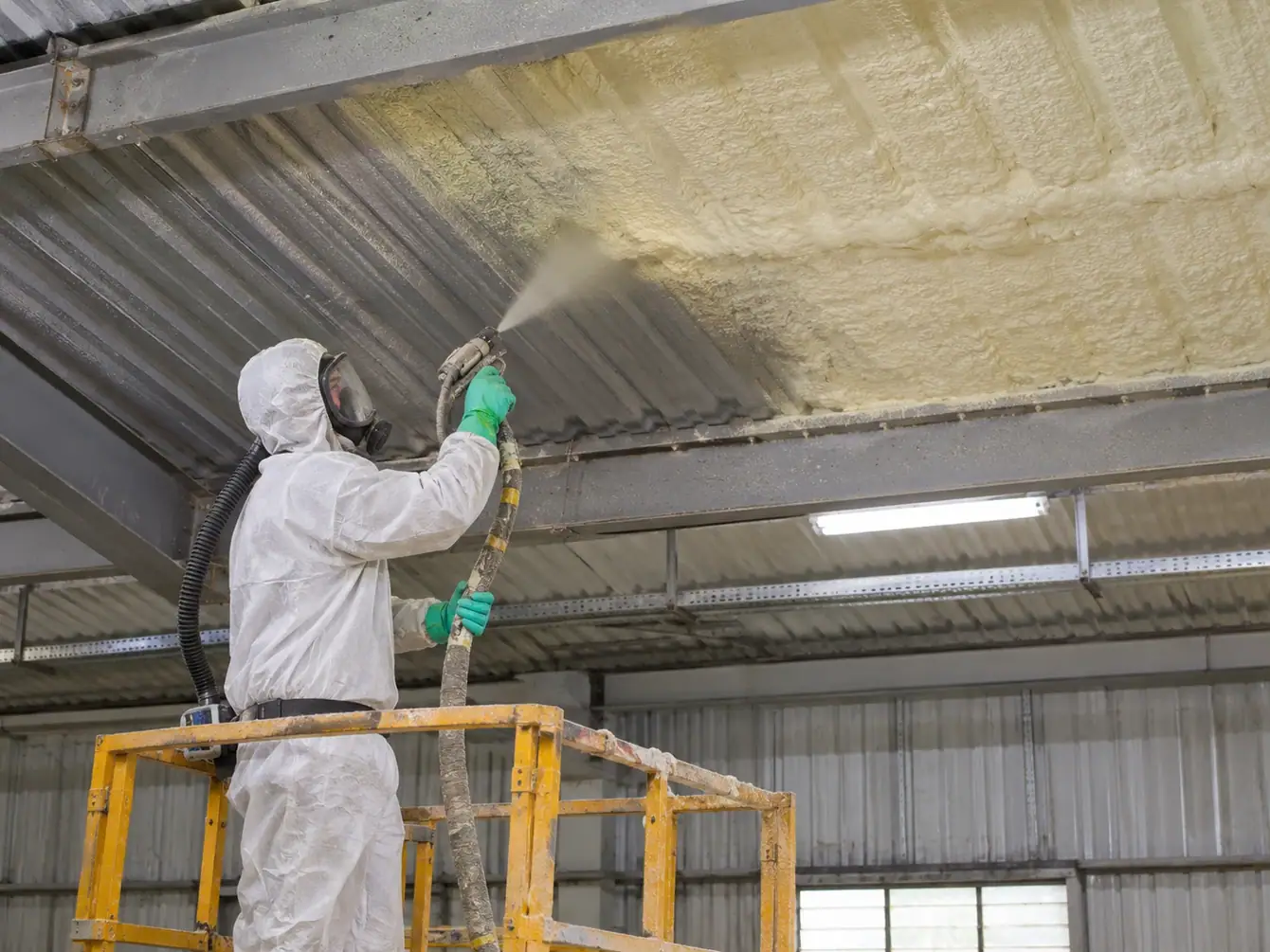
What is Rigid PU Spray Insulation?
Rigid Polyurethane spray insulation is a plural-component polymeric coating — seamless, monolithic and highly rigid. It is resistant to water, moisture and chemicals/solvents, and shows excellent adhesion to a variety of substrates including primed steel, aluminium and concrete.
Advantages of PU Spray Insulation
Lightweight
Foam density 40–50 kg/m³ — adds minimal load to structure. No structural reinforcement needed.
Seamless Application
Jointless in-situ insulation — no gaps, no cold bridges. 'R' value higher than any conventional insulation material.
Rapid Curing
Curing time of only 2 seconds. Foot traffic restored within 30 seconds on horizontal surfaces — faster project completion.
No Concrete Breaking
Applied by high-pressure machine spray method — no drilling or breaking of concrete required.
Green Building Compliant
Meets Green Building 'R' value requirements economically. K value of 0.018 Kcal/m.hr.°C — lowest among all insulation materials.
Chemical Resistance
Unaffected by moisture, water, chemicals and solvents. Suitable for harsh industrial environments.
Technical Specification
| Parameter | Value |
|---|---|
| Foam Density | 40–50 kg/m³ |
| Thermal Conductivity (K value) | 0.018 Kcal/m.hr.°C |
| Compressive Resistance | 280 kPa |
| Cure Time | 2 seconds |
| Foot Traffic (Horizontal) | 30 seconds after spray |
| Substrate | Primed Steel, Aluminium, Concrete |
| Water Absorption | Negligible (closed-cell structure) |
PU Injection into Tanks and Pipes
Spraying works where the surface is open. On a vessel or a pipe run that already has an outer jacket, the foam is injected into the annular cavity instead — the same two-component rigid polyurethane, dispensed under pressure through injection ports and allowed to rise and cure until the cavity is packed solid.
Why injection rather than spray
- The insulation is enclosed from the first minute, so there is no exposed foam to degrade in sunlight and no separate cladding operation afterwards
- No seams and no joints in the foam, so moisture has no path to track along the pipe and there is no cold bridge at a lap
- The cavity fills to its corners — around nozzles, saddles, supports and dished ends, where a sprayed coat thins out
- It can be done on an installed line without stripping and re-cladding the run
Where we use it
- Storage and process tanks, chilled water and thermal buffer vessels
- Pre-insulated pipe made in the plant, and the site joints on those lines
- Underground and above-ground chilled water and hot water distribution
- Cryogenic and LNG lines, where continuity of the insulation decides the boil-off rate
- Cold room floors, and any cavity a spray gun cannot reach
Specification — injected PUF
| Parameter | Specification |
|---|---|
| Method | Two-component rigid PUF injected into the annular cavity under pressure, then left to rise and cure in place |
| Core density | 36 to 60 kg/m³, set to the service temperature and the load on the insulation |
| K-value | 0.018 kcal/m·hr·°C |
| Service temperature | −185 °C to +110 °C |
| Cavity width | 25 mm to 150 mm, packed solid with no voids |
| Outer jacket | GI, aluminium, stainless steel or HDPE, depending on exposure |
On existing plant: send the vessel or line dimensions, the operating temperature and the jacket you have. Injection is usually possible without taking the line out of service for longer than the cure time.
Applications
- Over-deck insulation (rooftops, terraces)
- Under-deck insulation (underside of roof slabs)
- Thermal insulation of chilled water pipes
- Tank and vessel insulation
- Cold storage and refrigeration insulation
- Industrial pipe insulation at site
- Duct thermal insulation (spray application)
Why Choose Shree Venus for PU Spray?
- Experienced, trained applicators using high-pressure spray machines
- Consistent foam quality ensured through calibrated equipment
- Works on irregular surfaces — complete filling and sealing guaranteed
- Easy maintenance and repair of sprayed surfaces
- PAN India project execution capability